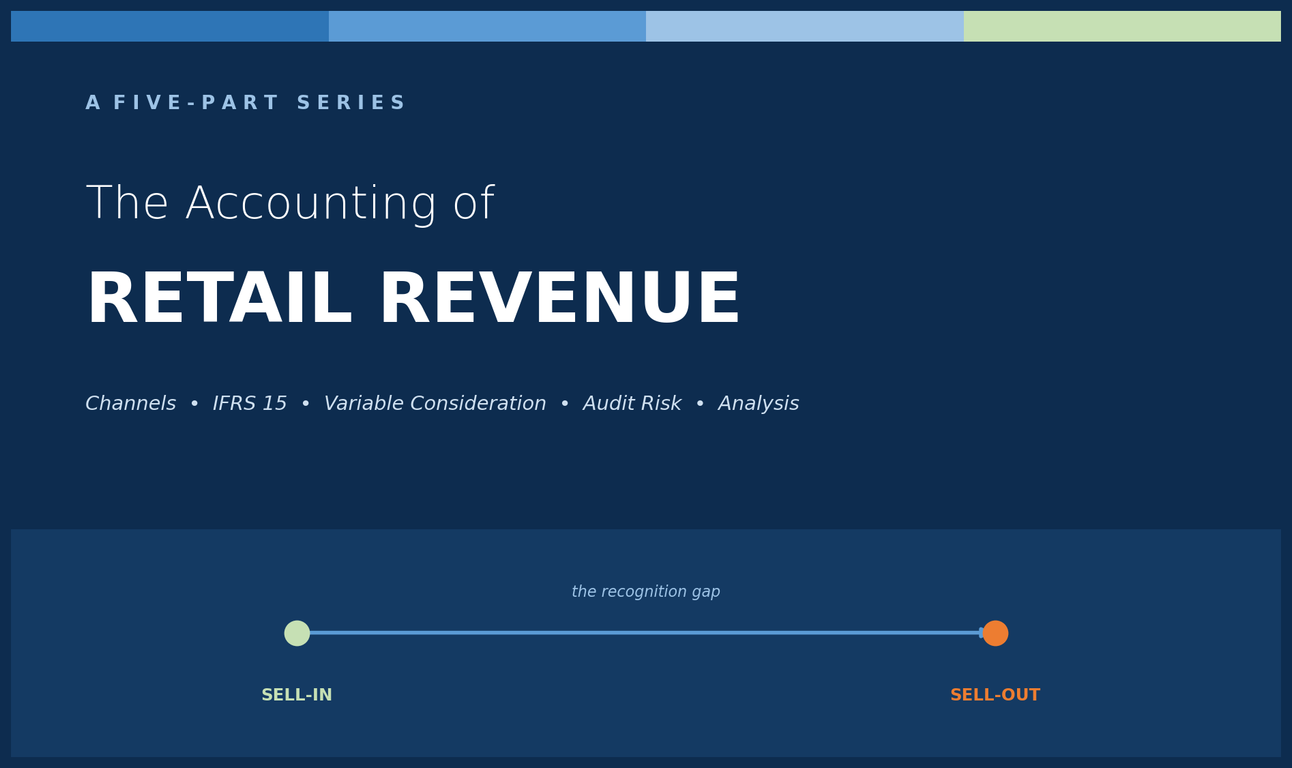
Why the Customer Is Not Always Who You Think It Is
Why This Matters
In Part 1, we explored how retail companies sell products through different distribution channels.
Whether products are sold through department stores, franchise stores, concession arrangements, or direct-operated stores, the accounting outcome often depends on one fundamental question:
At first glance, the answer seems obvious.
However, accounting often reaches a different conclusion
The IFRS 15 Five-Step Model
Revenue recognition under IFRS 15 follows a five-step framework.
| Step | Description |
|---|---|
| Step 1 | Identify the Contract |
| Step 2 | Identify Performance Obligations |
| Step 3 | Determine the Transaction Price |
| Step 4 | Allocate the Transaction Price |
| Step 5 | Recognise Revenue |
- Contract
- Performance obligations
- Transcation price
- Price allocation
- Timing of revenue recognition
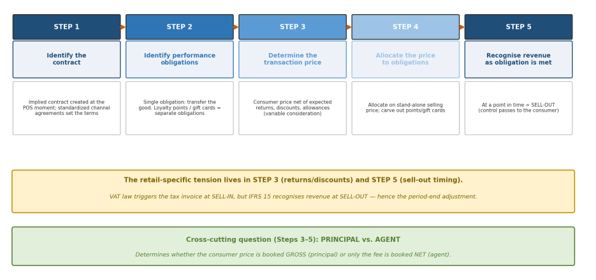
Although the framework applies to all industries, retail companies encounter a unique challenge in Step 1.
A department store may receive the product, but is it really the customer?
Step 1: Identifying the Customer
For many retail transactions, two parties appear between the brand and the final consumer.
Consider a department store arrangement.
Brand ? Department Store ? Consumer
At first glance, it may appear that the department store is the customer.
However, accounting is concerned with economic substance rather than legal form.
In many retail arrangements:
- The brand controls pricing.
- The brand bears inventory risk.
- The brand determines promotional activities.
- The brand ultimately earns the economic benefit from the sale.
As a result, the department store often functions as an intermediary rather than the customer.
Brand ? Consumer
This distinction explains why many retail companies recognise revenue when products are sold to consumers rather than when products are delivered to retailers.
Step 2: Identifying Performance Obligations
For a typical retail sale, the analysis is relatively straightforward.
Common Retail Performance Obligations
| Transaction Type | Performance Obligation |
|---|---|
| Standard Product Sale | Deliver Product |
| Loyalty Programme | Product + Loyalty Points |
| Gift Card | Future Delivery of Product |
| Membership Benefits | Product + Future Services |
Most retail transactions involve a single performance obligation: transferring control of a product.
However, loyalty points, gift cards, and membership programmes may create additional obligations that must be accounted for separately.
We will revisit these items in series 3.
Step 3: Determining the Transaction Price
At first glance, the transaction price seems easy to determine.
A customer purchases a jacket for $100.
Revenue equals $100.
Simple.
Unfortunately, retail businesses rarely operate under such ideal conditions.
In practice, transaction price is rarely fixed. It may be affected by :
- Returns
- Coupons
- Rebates
- Promotional discounts
- Loyalty rewards
As a result, retail revenue is often an estimate rather than a fixed amount.
This estimation process is known as variable consideration and represents one of the most important areas of judgment under IFRS 15.
Step 4: Allocating the Transaction Price
For most retail transactions, Step 4 is relatively simple.
A single product is sold for a single price.
No allocation is required.
However, allocation becomes important when multiple performance obligations exist.
Examples include:
- Product + loyalty points
- Product + membership benefits
- Coupons
- Product bundles
The price at which a promised good or service would be sold separately to a customer under similar circumstances.
In such cases, the transaction price must be allocated based on relative standalone selling prices.
Step 5: Recognising Revenue
This is the step most people associate with revenue recognition.
Revenue is recognised when control transfers to the customer.
When Is Revenue Recognised?
| Event | Typical IFRS 15 Outcome |
|---|---|
| Product Delivered to Department Store | Usually No Revenue |
| Product Purchased by Consumer | Revenue Recognised |
| Product Returned | Revenue Adjusted |
Revenue is recognised when control transfers not necessarily when products are physically delivered.
Although products may physically leave the warehouse earlier, revenue is generally recognised only when control passes to the end consumer.
Principal vs Agent
The most important judgment in retail accounting is often not the timing of revenue recognition.
It is determining whether the company acts as a principal or an agent.
The entity controls the goods before transfer and recognises revenue on a gross basis
The entity arranges for another party to provide the goods and recognises only the commissions
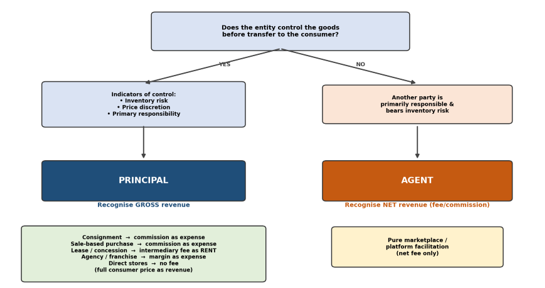
| Indicator | Principal | Agent |
|---|---|---|
| Controls Product Before Sale | Yes | No |
| Bears Inventory Risk | Yes | No |
| Controls Pricing | Yes | No |
| Revenue Presentation | Gross | Net |
When a company acts as a principal, revenue is presented on a gross basis.
When a company acts as an agent, only the commission or fee is recognised as revenue.
This single judgment can dramatically change reported revenue, gross margin ratios, and financial statement analysis.
Connecting Back to Series 1
- Seires 1 explained how products move through retail channels.
- Seires 2 explained why revenue recognition differs across those channels
- IFRS 15 focuses on economic substance, not legal form
- Revenue is generally recognised at sell-out, not sell-in
Understanding this principle makes the accounting differences between retail channels much easier to explain.
Final Thoughts
Retail revenue accounting is often perceived as a question of timing.
In reality, it is first a question of identifying the customer.
- Revenue follows control, not physical delivery
- The customer is often the end consumer, not the intermediary
- Principal vs Agent determines Gross vs Net revenue
- Economic substance is more important than legal form
In Part 3, we will move from timing to measurement and explore how returns, coupons, discounts, loyalty programmes, and gift cards create the estimation challenges collectively known as variable consideration.
Thanks for reading!