Why the Same Consumer Payment Can Become Two Completely Different Revenue Figures
One transaction. Two completely different financial statements.
What You’ll Learn
After reading this article, you’ll be able to:
- Explain why identical marketplace transactions can produce different revenue figures
- Distinguish GMV from recognised revenue
- Understand why ‘Principal vs Agent’ is the master variable in platform accounting
- Recognise why business models matter more than payment flows
Key Concepts
| Term | Simple Definition |
|---|---|
| Marketplace | A platform connecting buyers and sellers |
| GMV | The total value of transactions processed through the platform |
| Revenue | The amount recognised under IFRS 15 |
| Take Rate | The platform’s retained commission |
| Principal | Controls the promised good or service before transfer |
| Agent | Arranges for another party to provide the good or service |
Why This Matters
Every market place transaction looks deceptively simple.
1) A customer places an order
2) Payment is made
3) A product or service is delivered
From the customer’s perspective, every transaction appears almost identical.
From an accountant’s perspective, however, two transactions that look exactly the same may produce completely different financial statements.
One platform may recognise the entire consumer payment as revenue. But another may recognise the commission it retains for arranging the transaction.
The cash flow is identical. The economics are identical.
But reported revenue is not. This single distinction lies at the heart of platform-commerce accounting.
It determines how revenue is recognised, how margins are presented, how investors interpret financial statements, and ultimately how the business itself is perceived.
Before discussing IFRS 15, journal entries, or audit procedures, we therefore need to understand a much simpler question.
What exactly does a marketplace platform sell?
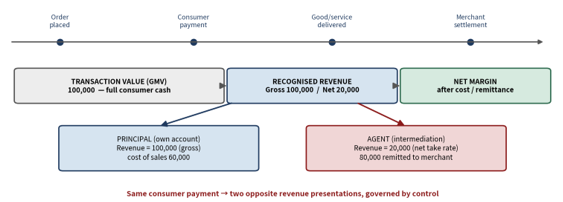
Diagram 1. One consumer payment, Two financial statements
Insight
The accounting follows the business model – not the payment flow.
This is perhaps the most important idea in the entire series. Many readers assume that because the platform collects the customer’s payment, the full amount must be revenue.
But IFRS does not ask who collects the cash. It asks who controls the promised good or service before it is transferred to the customer.
That single question determines whether the platform reports gross revenue or only its commission.
Befor we talk about revenue
Before discussing accounting, we need to distinguish one operating metric from one accounting metric. Platform business often report Gorss Merchandise Value(GMV) alongside revenue. Although the two numbers are closely related, they measure very different things.
| Metric | What It Represents |
|---|---|
| GMV | The total value of transactions processed through the platform |
| Revenue | The amount recognised under IFRS 15 |
Imagine a customer purchases a product worth 100,000 through an online marketplace.
Regardless of how the transaction is accounted for, GMV is always 100,000.
Revenue, however, may be:
- 100,000
- or 20,000
depending on the platform’s role. That distinction forms the foundation of this entire series.
A standard transaction
Throughout this series, we will use one standardised example.
Keeping the economies constant allows us to isolate the accounting.
| Item | Amount |
|---|---|
| Customer Payment | 100,000 |
| Amount Owed to Merchant | 80,000 |
| Platform Take Rate | 20,000 |
Now consider two different accounting outcomes.
| Platform Role | Revenue | Cost of Sales | Gross Profit |
|---|---|---|---|
| Principal | 100,000 | 80,000 | 20,000 |
| Agent | 20,000 | – | 20,000 |
The platform earns exactly the same economic profit in both cases. Yet reported revenue differs by a factor by five.
Everything an external reader believes about the size, growth, and profitability of the business begins with this distinction.
The Anatomy of a Marketplace transaction
A marketplace transaction can be broken into four operational events. Although every platform follows roughly the same sequence, the timeline itself does not determine the accounting.
| Stage | Operational Event | Accounting Question |
|---|---|---|
| 1 | Customer places an order | Is there a contract? |
| 2 | Customer makes payment | Who controls the consideration? |
| 3 | Goods or services are delivered | Who controls the promised good or service? |
| 4 | Cash is remitted to the merchant | How much consideration belongs to the platform? |
Notice something important. Nothing in this timeline tells us whether revenue should be recognised on a gross or net basis. The accounting answer is determined not by the sequence of events, but by the platform’s role within those events.
Three Numbers Every Platform Analyst Must Separate
One of the most common analytical mistakes is treating three very different numbers as if they were interchangeable.
| Metric | Meaning | Accounting Metric? |
|---|---|---|
| GMV | Total value of all transactions processed through the platform | X |
| Revenue | Amount recognised under IFRS 15 | O |
| Net Margin | Profit remaining after operating costs | X |
For our standard example:
- GMV = 100,000
- Revenue = either 100,000 or 20,000
- Economic Margin = 20,000
These three numbers answer three different questions.
GMV measures platform activity.
Revenue measures what IFRS permits the entity to recognise.
Profit measures the economic benefit retained by the operator.
Confusing them is the starting point of many analytical errors.
The two Marketplace archetypes
Every marketplace arrangement ultimately falls into one of two broad models.
| Business Model | Controls the Good or Service? | Revenue Presentation |
|---|---|---|
| Principal | Yes | Gross Revenue |
| Agent | No | Net Revenue |
This distinction is the master variable of platform-commerce accounting. It determines whether the platform reports the entire consumer payment as revenue or only the amount retained for facilitating the trasaction.
The legal form of the arrangement tells us very little. The operational timeline tells us very little. The payment flow tells us very little.
What matters is Control. That is the question IFRS 15 asks. And that is the question we will answer in the next article.
Real World Case
| Company | Typical Business Model | Typical Revenue Presentation |
|---|---|---|
| Amazon Retail (1P) | Principal | Gross |
| Amazon Marketplace (3P) | Agent | Net |
| Airbnb | Agent | Net |
| Uber | Agent | Net |
| Coupang (Direct Retail) | Principal | Gross |
Although these companies operate digital platforms, they do not necessarily report revenue in the same way. Understanding their business models is the first step toward understanding their financial statements.
Global CPA takeaways
| Key Idea | Why It Matters |
|---|---|
| Marketplace accounting begins with the business model. | Accounting follows how value is created. |
| Principal vs. Agent is the master variable. | It determines gross versus net revenue presentation. |
| GMV is not revenue. | Operating metrics and accounting metrics should never be confused. |
| Identical economics can produce different reported revenue. | Financial statements reflect accounting judgments as well as business activity. |
| Control—not cash collection—drives IFRS 15. | Revenue recognition depends on who controls the promised good or service. |
Before moving to Series 02
Before continuing, make sure you can answer these quetions.
- What is GMV, and how is it different from revenue?
- Why can the same customer payment produce different reported revenue?
- Why is the principal-versus-agent assessment so important?
- Why can’t we determine revenue simply by looking at the payment flow?
If these questions are still unclear, revisit the diagrams in this article before moving to Series 02.
Final Thoughts
At first glance, platform commerce appears to be a simple business of connecting buyers and sellers. From an accounting perspective, however, that simplicity is deceptive.
Two platforms may process the same customer payment, generate the same economic profit, and provide an almost identical customer experience—yet report entirely different revenue figures.
That difference is not explained by cash collection, payment timing, or legal form.
It begins with a single question:
Does the platform control the promised good or service, or does it merely arrange for another party to provide it?
That question is the foundation of platform-commerce accounting.
In series 2, we will rebuild this same transaction using the IFRS 15 five-step model and identify precisely where the gross-versus-net decision is made.
Thanks for reading!