Reconstructing a Marketplace Transaction Under IFRS 15
The answer isn’t in the cash flow. It’s in control.
What you’ll learn
1) Apply the IFRS 15 five-step model to a marketplace transaction
2) Understand where the gross vs net decision actually occurs
3) Identify the customer and the performance obligation
4) Explain why principal vs agent is embedded within in IFRS15
Looking Back
In Part 1, we established one fundamental idea.
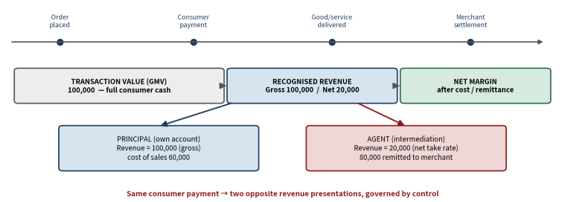
The same customer payment can produce two completely different revenue figures.
A platform may recognise:
- 100,000 as revenue, or
- 20,000 as revenue,
Even though the customer pays exactly the same amount.
That difference is determined by whether the platform acts as a principal or an agent. But this raises a much more important question.
How does IFRS 15 actually reach that conclusion?
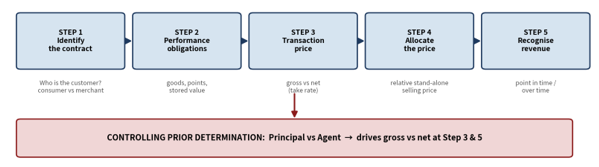
Many people think principal vs agent is a separate accounting test. But it isn’t. It is embedded within the five-step revenue recognition model.
To understand why, we’ll reconstruct the same marketplace transaction using IFRS 15.
Key Concepts
| Term | Simple Definition |
|---|---|
| Contract | An agreement creating enforceable rights and obligations |
| Customer | The party receiving the promised goods or services |
| Performance Obligation | What the entity promises to transfer |
| Transaction Price | The consideration the entity expects to receive |
| Control | The ability to direct the use of a good or service before transfer |
Standard Transaction
We’ll continue using the same example introduced in part 1
| Item | Amount |
|---|---|
| Customer Payment | 100,000 |
| Merchant Receives | 80,000 |
| Platform Take Rate | 20,000 |
The economies will not change. Only the accounting analysis will.
The IFRS 15 Roadmap
Before diving into each step, it helps to see the overall framework again.
| Step | Question | Why It Matters in a Marketplace |
|---|---|---|
| Step 1 | Is there a contract? | Multiple contracts may exist. |
| Step 2 | What has been promised? | Goods, intermediation, delivery, loyalty points, and other services may all be separate obligations. |
| Step 3 | How much consideration belongs to the platform? | This is where gross-versus-net begins to emerge. |
| Step 4 | Does the transaction price need to be allocated? | Multiple performance obligations require allocation. |
| Step 5 | When is each obligation satisfied? | Revenue follows control, not cash collection. |
Step 1 – Identify the Contract
For a traditional retailer, Step 1 is usually straightforward. A retailer enters into a contract with its customer. A marketplace is different. There are often multiple contractual relationships.
| Contract | Typical Parties |
|---|---|
| Marketplace Agreement | Platform ? Merchant |
| Purchase Agreement | Customer ? Platform or Merchant |
| Payment Service | Platform ? Customer |
Simply identifying the relevant contract is already more complex than in a conventional retail business.
Step 2 – Identify the Performance Obligations
The next question is:
What exactly has the platform promised?
That promise may be:
1) Delivering a product,
2) Arranging a transaction,
3) Processing payment,
4) Providing logistics,
5) Issuing loyalty points, or offering post-sale support.
The answer determines what the platform is actually selling. And this is where principal-versus-agent begins to matter. IFRS 15 asks whether the platform controls the promised good or service before it is transferred to the customer.
If it does, it is likely acting as a principal. If it merely arranges for another party to provide the good or service, it is likely acting as an agent.
Notice that the question is not who collected the cash. It is what the platform promised to deliver.
Step 3 – Determine the Transaction Price
This is where the accounting paths begin to diverge.
From our standard example :
| Scenario | Transaction Price Recognised |
|---|---|
| Principal | 100,000 |
| Agent | 20,000 |
The customer still pays 100,000. The platform still retains 20,000. Nothing has changed economically.
Only the platform’s entitlement has changed.
For a principal, the transaction price is the full amount received from the customer. For an agent, the transaction price is only the commission earned for arranging the sale.
This is the point where the gross vs net distinction becomes visible in the financial statements.
Step 4 – Allocate the Transaction Price
Many platform businesses promise more than one service.
For example:
- Marketplace access
- Delivery
- Extended warranties
- Loyalty programmes
- Digital credits
Each distinct performance obligation may require a portion of the transaction price to be allocated.
For simple marketplace transactions, this step may have little impact.
For complex digital platforms, however, allocation becomes an important accounting issue.
We’ll revisit this topic when we discuss loyalty programmes and platform incentives in Series 3.
Step 5 – Recognise Revenue
Revenue is recognised when control of each promised good or service transfers to the customer.
Notice something important.
The customer may have paid days earlier. The merchant may not yet have been settled. Neither event determines revenue recognition.
IFRS 15 focuses on one thing:
Has the promised performance obligation been satisfied?
That is why revenue follows control—not payment.
Journal Entries
1. Principal reconstruction (gross)
| Dr | Cash | 100,000 |
| Cr | Revenue | 100,000 |
| Dr | Cost of sales | 80,000 |
| Cr | Inventory | 80,000 |
2. Agent reconstruction (agent)
| Dr | Cash | 100,000 |
| Cr | Revenue (take rate) | 20,000 |
| Cr | Payable to merchant | 80,000 |
Real World Case
| Platform | What Is the Platform Primarily Providing? | Likely Presentation* |
|---|---|---|
| Amazon Retail | Goods | Gross |
| Amazon Marketplace | Intermediation Services | Net |
| Airbnb | Booking Platform | Net |
| Uber | Ride-Matching Platform | Net |
(*)Actual accounting depends on the specific contractual arrangement.
Global CPA Takeaways
| Key Idea | Why It Matters |
|---|---|
| Principal versus agent is part of IFRS 15. | It is not a separate accounting exercise. |
| The five-step model applies to platform businesses just as it does to any other contract. | The complexity lies in identifying what has actually been promised. |
| Cash collection does not determine revenue. | Revenue follows the transfer of control. |
| The gross-versus-net decision emerges from the analysis of the promised goods or services. | Understanding the business model is essential. |
| Every later accounting issue builds on these five steps. | This framework underpins the rest of the series. |
Before Moving to Part 3
Before continuing, make sure you can answer these questions:
- Why can a marketplace have multiple contracts?
- What is the platform’s actual performance obligation?
- At which step does the gross vs net distinction begin to emerge?
- Why doesn’t customer payment automatically determine revenue?
- Why is control central to IFRS 15?
In Series 3, we’ll move beyond recognition and explore measurement.
Even after identifying the correct revenue model, another challenge remains:
How much revenue should the platform actually recognise when returns, incentives, credits, and loyalty programmes introduce uncertainty?
Thanks for reading!