From One Customer Payment to One Set of F/S
One transaction. One accounting framework. One financial story.
Why This Guide Exists
Throughout this series, we followed a single marketplace transaction from beginning to end.
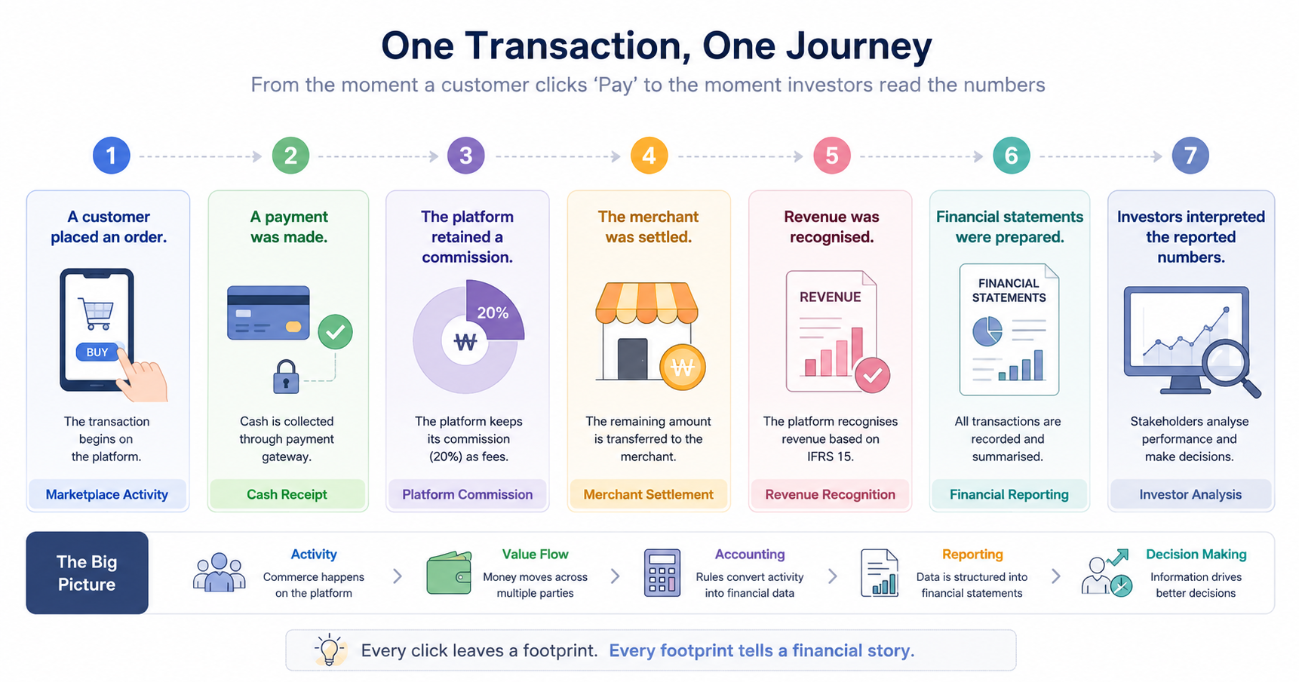
Each article focused on one stage of that journey.
This guide brings those stages together into a single framework.
Rather than introducing new accounting concepts, it shows how platform businesses transform everyday commercial transactions into IFRS-compliant financial reporting.
Platform Commerce Series
| Article | Focus |
|---|---|
| Series 01 | The Marketplace Map |
| Series 02 | Following the Money |
| Series 03 | When Revenue Becomes an Estimate |
| Series 04 | The Settlement Engine |
| Series 05 | Reading Platform Financial Statements |
| Understanding Platform Commerce Accounting | Series Framework & Big Picture |
If you’re reading this series for the first time, start here. If you’ve already completed the five articles, use this page as a one-page review.
The Platform Commerce Framework
Everything discussed throughout this series can be reduced to six business questions.
| Step | Business Question | Accounting Focus | Outcome |
|---|---|---|---|
| 1 | Who creates value? | Business Model | Marketplace Structure |
| 2 | Who controls the promised good or service? | IFRS 15 | Principal vs. Agent |
| 3 | How much consideration belongs to the platform? | Transaction Price | Revenue Measurement |
| 4 | How is the transaction processed? | Settlement & Controls | Financial Reporting |
| 5 | What do the financial statements show? | Presentation | Revenue & Liabilities |
| 6 | How should users interpret the numbers? | Financial Analysis | Better Business Decisions |
Every platform accounting issue begins with the business model and ends with financial statement interpretation.
From One Customer Payment to Financial Statements
This entire series can be summarised using a single journey.
| Stage | Business Event | Accounting Output |
|---|---|---|
| Customer places an order | Marketplace activity | GMV |
| Platform determines its role | Principal vs. Agent assessment | Revenue model |
| Transaction price is measured | Variable consideration | Revenue amount |
| Settlement is processed | Merchant payable & cash movements | Journal entries |
| Month-end close | Reconciliations & adjustments | Financial statements |
| Investors analyse results | GMV, Revenue & Take Rate | Business decisions |
Notice how revenue is only one step in a much larger process.
The Six Building Blocks
| Article | Core Message |
|---|---|
| Part 1 | Business models explain why identical transactions can produce different revenue figures. |
| Part 2 | IFRS 15 determines revenue by analysing control—not payment flows. |
| Part 3 | Revenue measurement often depends on estimates rather than fixed amounts. |
| Part 4 | Reliable financial reporting depends on strong settlement processes and internal controls. |
| Part 5 | Financial statements should always be interpreted alongside the underlying business model. |
One Transaction, Six Perspectives
The same marketplace transaction looks different depending on who is analysing it.
| Perspective | Primary Question |
|---|---|
| Customer | Can I buy the product? |
| Merchant | When will I receive payment? |
| Platform | How much commission do I earn? |
| Accountant | How should revenue be recognised? |
| Auditor | Can the accounting process be trusted? |
| Investor | What do the reported numbers actually mean? |
One transaction.
Six completely different perspectives.
The Platform KPI Framework
Platform businesses are rarely evaluated using revenue alone.
| KPI | What It Measures | Why It Matters |
|---|---|---|
| GMV | Commercial activity | Business scale |
| Revenue | IFRS-recognised income | Financial reporting |
| Take Rate | Monetisation efficiency | Pricing power |
| Gross Margin | Operating efficiency | Business quality |
| Operating Margin | Overall profitability | Long-term sustainability |
Understanding these KPIs together provides a much clearer picture than revenue alone.
Common Analytical Mistakes
| Instead of… | Think Like This |
|---|---|
| Compare revenue only | Compare business models first |
| Assume GMV is revenue | Separate operating KPIs from accounting metrics |
| Focus on payment flows | Focus on control under IFRS 15 |
| Ignore settlement | Settlement determines reporting quality |
| Analyse numbers in isolation | Understand how the platform creates value |
Platform Commerce Cheat Sheet
| Topic | Key Takeaway |
|---|---|
| GMV | Measures platform activity—not accounting revenue. |
| Principal vs. Agent | Determines gross versus net presentation. |
| Variable Consideration | Revenue is often estimated. |
| Settlement | Connects operations with accounting. |
| Take Rate | Measures monetisation rather than scale. |
| Financial Analysis | Business models always come before accounting ratios. |
Where Should You Start?
| If You Are… | Start Here |
|---|---|
| Accounting Student | Series 02 & Series 03 |
| CPA / ACCA Candidate | Read the full series |
| Auditor | Series 04 |
| Financial Analyst | Series 05 |
| Finance Team Member | Series 01 & Series 04 |
| Platform Founder | Series 01 & Series 05 |
Global CPA Takeaways
| Lesson | Why It Matters |
|---|---|
| Business models determine accounting outcomes. | Accounting follows commercial substance. |
| Control matters more than payment flows. | IFRS 15 focuses on who controls the promised good or service. |
| Revenue is both recognised and measured. | Recognition and measurement are separate accounting decisions. |
| Operational excellence improves financial reporting. | Good accounting depends on good processes. |
| Financial statements only tell part of the story. | GMV, Take Rate, and business models provide essential context. |
Final Thoughts
When people first encounter platform accounting, they often assume the biggest challenge is understanding IFRS 15.
In my experience, that isn’t the hardest part. The real challenge is understanding the business itself.
Platform companies create value differently from traditional retailers. They connect buyers and sellers, facilitate transactions, manage payment flows, and build digital ecosystems rather than simply selling products.
Those business characteristics shape every accounting decision that follows—from revenue recognition and transaction price measurement to settlement processes and financial statement analysis.
That is why this series began with the marketplace rather than the accounting standards.
Once we understand how a platform creates value, the accounting becomes much easier to understand. And perhaps that is the broader lesson beyond platform businesses.
Accounting is never just about numbers. It is about faithfully representing how a business creates economic value.
Appendix A – Platform Commerce Roadmap
| Stage | Key Question | Output |
|---|---|---|
| Business Model | Who creates value? | Marketplace Structure |
| Revenue Recognition | Who controls the promised good or service? | Principal vs. Agent |
| Measurement | How much revenue should be recognised? | Transaction Price |
| Settlement | How are transactions processed? | Journal Entries |
| Reporting | What appears in the financial statements? | Revenue & Liabilities |
| Analysis | What do the numbers actually mean? | Better Decisions |
Appendix B – Key IFRS References
| Topic | IFRS Reference |
|---|---|
| Contract Identification | IFRS 15.9–16 |
| Performance Obligations | IFRS 15.22–30 |
| Transaction Price | IFRS 15.47–72 |
| Variable Consideration | IFRS 15.50–59 |
| Principal vs. Agent | IFRS 15.B34–B38 |
| Contract Liabilities | IFRS 15.106–109 |
| Breakage | IFRS 15.B44–B47 |