Why GMV Often Matters More Than Revenue
Never compare platform revenue before understanding the business model.
What You’ll Learn
1) Understand how investors analyse platform businesses
2) Distinguish GMV from reported revenue
3) Interpret Take Rate and Gross vs Net presentation
4) Avoid common mistakes when comparing platform companies
Looking Back
Throughout this series, we have followed the same marketplace transaction from multiple perspectives.
In series 1, we explored the business model.
In series 2, we applied the IFRS 15 five-step model.
In series 3, we measured revenue.
In series 4, we transformed operational data into financial statements.
Now we take one final step.
Instead of asking how accountants prepare financial statements, we ask a different question.
How should readers interpret them?
Because once the numbers are published, accounting becomes analysis.
Key Concepts
| Term | Simple Definition |
|---|---|
| GMV | Total transaction value processed by the platform |
| Revenue | Amount recognised under IFRS |
| Take Rate | Revenue ÷ GMV |
| Gross Revenue | Revenue reported as principal |
| Net Revenue | Revenue reported as agent |
| Unit Economics | Profitability of an individual transaction |
Looking Beyond Revenue
One of the most common mistakes when analysing platform companies is focusing only on reported revenue.
Revenue tells only part of the story.
A platform processing $10 billion of transactions may report less revenue than a retailer processing $3 billion.
That does not necessarily mean the retailer has a larger business. It simply means the two businesses recognise revenue differently.
Understanding the business model always comes before comparing the numbers.
Three Numbers Every Investor Should Read Together
| Metric | What It Measures | Why It Matters |
|---|---|---|
| GMV | Total economic activity | Business scale |
| Revenue | IFRS-recognised sales | Accounting presentation |
| Operating Profit | Economic performance | Profitability |
Each metric answers a different question.
Looking at only one almost always leads to an incomplete conclusion.
The Importance of Take Rate
GMV tells us how much commerce flows through the platform. Revenue tells us how much the platform recognises.
Take Rate tells us how effectively the platform monetises that activity.
| Scenario | GMV | Revenue | Take Rate |
|---|---|---|---|
| Platform A | 1,000 | 100 | 10% |
| Platform B | 1,000 | 200 | 20% |
Both platforms facilitate exactly the same transaction volume. Yet Platform B converts twice as much of that activity into recognised revenue.
This may reflect stronger pricing power, broader services, or a different business model.
Why Revenue Can Be Misleading
Imagine two companies.
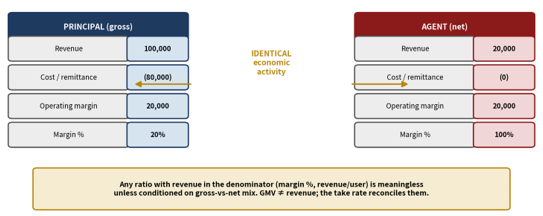
| Company | GMV | Revenue | Business Model |
|---|---|---|---|
| Company A | 10,000 | 10,000 | Principal |
| Company B | 10,000 | 2,000 | Agent |
Which company is larger?
Revenue alone suggests Company A.
GMV suggests both facilitate the same amount of commerce.
Neither answer is complete without understanding the accounting model. This is why experienced investors rarely analyse platform companies using revenue alone.
Real World Case
| Company | Primary Metric Investors Watch | Why? |
|---|---|---|
| Amazon | Revenue + GMV | Mixed business model (1P + 3P) |
| Airbnb | Gross Booking Value | Better reflects platform activity |
| Uber | Gross Bookings | Complements IFRS revenue |
| Coupang | Revenue | Principal model makes revenue more representative |
Different business models require different analytical approaches.
Common Analytical Mistakes
| Mistake | Better Question |
|---|---|
| Comparing revenue directly | Compare business models first |
| Ignoring GMV | Measure the scale of platform activity |
| Focusing only on growth | Examine Take Rate and margins |
| Treating Gross and Net revenue as equivalent | Understand the principal-versus-agent assessment |
| Ignoring accounting policies | Read the revenue recognition note |
Global CPA Takeaways
| Key Idea | Why It Matters |
|---|---|
| Revenue is only one measure of platform performance. | GMV and Take Rate often provide additional insight. |
| Business models shape reported revenue. | Similar economics can produce different accounting outcomes. |
| Accounting presentation influences financial analysis. | Gross and Net revenue should never be compared blindly. |
| Good analysts understand both IFRS and the business model. | Neither alone is sufficient. |
| Financial statements tell a story—but only if we know how to read them. | Context is everything. |
Before Reading the Summary Guide
You should now be able to answer these questions.
- Why isn’t GMV an accounting measure?
- Why can two similar platforms report very different revenue?
- Why is Take Rate often more informative than revenue growth?
- Why should investors read accounting policies before comparing platform companies?
- How does the business model influence financial statement analysis?
The next article brings together everything we’ve covered throughout this series into one practical framework.
Final Thoughts
Financial statements are often viewed as the final product of accounting.
In reality, they are only the beginning. For platform businesses, reported revenue reflects a series of judgments about business models, control, measurement, settlement, and presentation.
Without understanding those judgments, comparing two companies can lead to misleading conclusions.
That is why this series began with the business model rather than the accounting standards.
Business models determine accounting. Accounting determines financial statements. And financial statements shape how the market understands a business.
For platform companies, those three ideas are inseparable.
“Throughout this series, we followed a single marketplace transaction from the moment a customer clicked ‘Pay’ to the moment an investor analysed the financial statements.”
“In the final article, we’ll bring those pieces together into a single framework—showing how one transaction becomes one set of financial statements.”
Thanks for reading!
Appendix A – Platform KPI Guide
| KPI | Purpose | Typical User |
|---|---|---|
| GMV | Measure transaction volume | Investors |
| Revenue | IFRS reporting | Accountants |
| Take Rate | Monetisation efficiency | Management |
| Gross Margin | Profitability | Analysts |
| Operating Margin | Overall performance | Investors |
Appendix B – Financial Statement Reading Checklist
Before analysing a platform company, ask yourself:
| Question | ? |
|---|---|
| What is the company’s business model? | ? |
| Does it primarily act as a principal or an agent? | ? |
| Which KPI best reflects business scale—GMV or Revenue? | ? |
| Has the Take Rate changed over time? | ? |
| Have accounting policies changed? | ? |