Why Revenue Recognition Doesn’t End with Gross vs. Net
Revenue isn’t always collected. Sometimes it’s estimated.
What you’ll learn
1) Understand why determining gross or net revenue is only the beginning
2) Learn how variable consideration affects platform revenue
3) Identify common estimation issues in digital platforms
4) Understand why transaction price is rarely a fixed amount
Looking Back
In Part 2, we reconstructed a marketplace transaction using the IFRS 15 five-step model.
We concluded that the principal vs agent assessment determines whether a platform reports revenue on a gross or net basis.
That conclusion answers one question.
How should revenue be presented?
A second question immediately follows.
How much revenue should actually be recognised?
At first glance, the answer seems obvious. If the platform earns a commission of 20,000, shouldn’t revenue simply be 20,000?
Not necessarily.
Even after identifying the correct revenue model, the transaction price itself may still be uncertain. That uncertainty is known as variable consideration.
Key concepts
| Term | Simple Definition |
|---|---|
| Transaction Price | The consideration the entity expects to be entitled to receive |
| Variable Consideration | Consideration that may change depending on future events |
| Refund Liability | Expected refunds to customers |
| Contract Liability | Amount received before satisfying a performance obligation |
| Breakage | Expected value of unused customer rights |
The Transaction Doesn’t End at Checkout
One of the biggest misconceptions about platform accounting is that revenue is determined when the customer pays.
In reality, payment is often only the beginning.
A customer may later:
- return the product,
- receive promotional credits,
- redeem loyalty points,
- cancel the booking,
- or use a discount voucher.
Each of these events changes the amount the platform ultimately expects to retain. Revenue therefore becomes an estimate rather than a fixed number.
The Same Transaction Can Change Over Time
We’ll continue using our standard transaction.
| Item | Amount |
|---|---|
| Customer Payment | 100,000 |
| Merchant Receives | 80,000 |
| Platform Commission | 20,000 |
Suppose the platform later issues a promotional credit worth 2,000. The economics have changed. The platform may no longer expect to retain the full 20,000.
The transaction price must therefore be reassessed.
Common Sources of Variable Consideration
Digital platforms constantly adjust prices and incentives. These commercial practices create accounting consequences.
| Platform Feature | Typical Accounting Impact |
|---|---|
| Coupons | Reduce transaction price |
| Promotional Credits | Variable consideration |
| Cash Rewards | Reduction of revenue or marketing expense (depending on substance) |
| Loyalty Programmes | Separate performance obligation |
| Gift Cards | Contract liability |
| Refunds | Refund liability |
Notice something important. Most of these items do not create new revenue. They reduce, defer, or reallocate existing revenue.
Not Every Customer Right Is Exercised
Not every customer benefit is used. Some gift cards are never redeemed. Some promotional credits expire. Some loyalty points remain unused.
Although these situations look operational, they have direct accounting consequences.
Customer Rights and Their Accounting
| Customer Right | Initial Accounting | What Happens Later? |
|---|---|---|
| Gift Card | Contract Liability | Revenue recognised when redeemed or when breakage becomes highly probable |
| Loyalty Points | Contract Liability | Revenue recognised as points are redeemed |
| Promotional Credit | Variable Consideration | Revenue adjusted based on expected utilisation |
Notice that these items are not recognised as revenue immediately.
Instead, the platform first records a liability because it still owes goods or services to the customer.
Only after that obligation is satisfied—or expires—can revenue be recognised.
What Is Breakage?
One interesting feature of digital platforms is that not every customer right is exercised. Some customers never redeem their gift cards. Others forget to use promotional credits.
Unused customer rights are referred to as breakage.
Under IFRS 15, expected breakage may be recognised as revenue only when the entity expects that the customer will not exercise the remaining rights.
This means revenue can increase without any additional cash being received.
That idea often surprises people. The cash was collected long ago. What changed was management’s expectation about customer behaviour.
Why Platform Businesses Are Different
Variable consideration exists in many industries. Platform businesses, however, rely heavily on incentives to stimulate demand.
Think about companies such as:
- Uber offering ride credits,
- Airbnb issuing travel coupons,
- Food delivery platforms providing promotional vouchers,
- Online marketplaces rewarding repeat purchases.
These incentives are part of the business model. As a result, estimation is not an exception. It is a routine part of revenue recognition.
From Fixed Prices to Expected Consideration
Under IFRS 15, revenue is based on the amount the entity expects to be entitled to receive.
That expectation may differ from the amount initially collected.
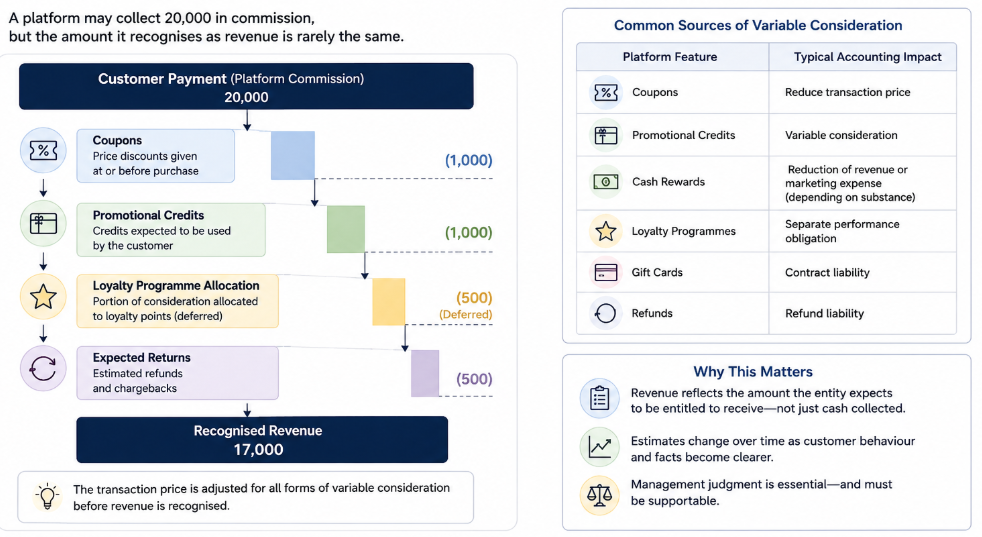
| Scenario | Cash Collected | Expected Revenue |
|---|---|---|
| No Promotion | 20,000 | 20,000 |
| Promotional Credit Expected | 20,000 | 18,000 |
| Partial Refund Expected | 20,000 | 19,000 |
| Loyalty Points Issued | 20,000 | Partially Deferred |
This is one of the defining features of IFRS 15. Revenue reflects expected economic benefit, not simply cash receipts.
Real World Case
| Platform | Common Estimation Issue |
|---|---|
| Uber | Ride credits and promotional incentives |
| Airbnb | Travel coupons and booking refunds |
| Amazon | Gift cards and promotional discounts |
| DoorDash | Delivery credits and loyalty rewards |
Although these programmes look like marketing tools, they often have direct implications for revenue recognition.
Why This Matters for Investors
Variable consideration affects far more than revenue. It also influences:
- reported growth,
- gross margin,
- deferred revenue,
- contract liabilities,
- and future earnings.
Two platforms may report identical commission income today. If one relies heavily on promotional incentives while the other does not, their future revenue patterns may differ significantly.
Revenue quality therefore depends not only on the business model, but also on the quality of management’s estimates.
Global CPA Takeaways
| Key Idea | Why It Matters |
|---|---|
| Gross vs. Net is only the first step. | Revenue must still be measured correctly. |
| Revenue is based on expected consideration. | Cash received is not always the final transaction price. |
| Platform incentives create estimation challenges. | Variable consideration is part of everyday platform accounting. |
| Marketing programmes often have accounting consequences. | Commercial decisions affect financial reporting. |
| Good estimates produce reliable financial statements. | Measurement is just as important as recognition. |
Before Moving to series 4
Before continuing, ask yourself:
- Why isn’t the transaction price always fixed?
- How do promotional incentives affect revenue?
- Why are loyalty programmes treated differently from simple discounts?
- Why does IFRS focus on expected consideration rather than cash collected?
- Why is revenue measurement an estimation exercise?
In series 4, we’ll move beyond recognition and measurement to execution.
We’ll examine how platform companies transform millions of transactions into IFRS-compliant financial statements—and why the settlement process often becomes one of the highest-risk areas in the audit.
Final Thoughts
By this point, the accounting framework has become much richer than it first appeared.
Series 1 showed that the business model determines whether revenue is reported on a gross or net basis.
Series 2 explained how that conclusion is reached through the IFRS 15 five-step model.
Series 3 introduces another layer of complexity.
Even after determining who should recognise revenue, we still need to determine how much revenue should be recognised.
In platform businesses, that answer is rarely fixed.
It depends on customer behaviour, promotional strategies, refunds, and management’s expectations about future outcomes.
Revenue recognition, therefore, is not simply about recording completed transactions. It is about measuring the economic benefit the platform ultimately expects to retain.
Thanks for reading!