How Millions of Transactions Become IFRS-Compliant Financial Statements
Cash moves automatically. Accounting rarely does.
What You’ll Learn
1) Understand how platform transactions flow into the accounting system
2) Learn why settlement is one of the highest-risk processes in platform businesses
3) Identify the key accounts used throughout the settlement cycle
4) Understand what auditors actually test during a platform audit
Looking Back
In series 2, we identified who should recognise revenue.
In series 3, we determined how much revenue should be recognised.
One important question still remains.
How does a platform transform millions of customer transactions into IFRS-compliant financial statements?
The answer lies in the settlement process. For many platform companies, settlement is not simply an operational process.
It is the accounting engine that connects customer payments, merchant settlements, revenue recognition, and financial reporting.
Understanding this process is essential—not only for accountants, but also for auditors and finance professionals responsible for ensuring the integrity of financial information.
Why Settlement Matters
Revenue recognition often receives most of the attention.
In practice, however, many accounting issues arise after revenue has already been recognised.
The challenge is no longer deciding whether revenue should be recognised.
The challenge is ensuring that millions of individual transactions are accurately processed, reconciled, settled, and ultimately reflected in the financial statements.
This is where the settlement process becomes the accounting engine of a platform business.
Key Concepts
| Term | Simple Definition |
|---|---|
| Settlement | The process of distributing customer payments to the appropriate parties |
| Merchant Payable | Amount owed to merchants after customer payment |
| Payment Gateway (PG) | Service provider that processes customer payments |
| Clearing Account | Temporary account used before final settlement |
| Reconciliation | Matching operational records with accounting records |
From Customer Payment to Financial Statements
A marketplace transaction does not end when the customer clicks “Pay.”
Instead, it moves through several operational and accounting stages before appearing in the financial statements.
| Stage | Operational Event | Accounting Focus |
|---|---|---|
| Customer Payment | Cash received through PG | Cash receipt |
| Payment Confirmation | Transaction validated | Sales recording |
| Settlement Calculation | Platform commission determined | Merchant payable |
| Merchant Settlement | Funds transferred | Liability settlement |
| Month-End Closing | Manual adjustments | Revenue recognition & accruals |
| Financial Reporting | Financial statements prepared | IFRS presentation |
Why Settlement Is More Complex Than It Looks
From a customer’s perspective, settlement appears almost instantaneous. Behind the scenes, however, a single transaction may involve:
- a payment gateway,
- the platform,
- one or more merchants,
- logistics providers,
- coupon providers,
- loyalty programmes,
- and banking institutions.
Each participant may have different contractual rights and different payment schedules.
As a result, accounting often requires multiple journal entries before a transaction reaches its final form. The settlement process is therefore not merely operational. It is one of the most important accounting processes within a platform business.
Why Merchant Payables Matter
When a customer pays through a platform, not all of the cash belongs to the platform. A significant portion usually belongs to the merchant. Until those funds are settled, the platform recognises an obligation.
That obligation is commonly presented as Merchant Payables (or a similar liability account). Only the commission retained by the platform ultimately becomes revenue.
Typical Journal Flow
Although journal entries vary between companies, the overall accounting flow is surprisingly consistent.
| Stage | Debit | Credit |
|---|---|---|
| Customer Payment | Cash | Merchant Payable |
| Commission Recognition | Merchant Payable | Revenue |
| Merchant Settlement | Merchant Payable | Cash |
| Month-End Adjustments | Various | Revenue / Liabilities |
The exact accounts differ across ERP systems, but the underlying accounting logic remains the same.
Where Errors Usually Occur
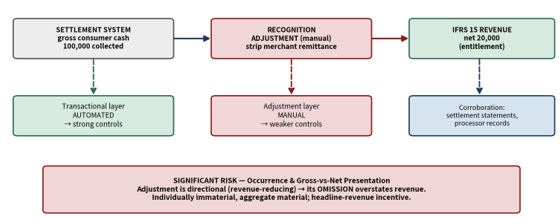
Settlement processes are highly automated. Accounting adjustments often are not. This creates several common risk areas.
| Risk Area | Why It Matters |
|---|---|
| Settlement Timing | Payments and revenue may fall into different reporting periods. |
| Manual Journal Entries | Increase the risk of human error. |
| Merchant Reconciliations | Differences between operational and accounting records. |
| Refund Processing | May require adjustments to previously recognised revenue. |
| Promotional Credits | Often involve estimates and manual calculations. |
Most audit findings do not arise because the accounting standards are misunderstood. They arise because operational processes fail to produce reliable accounting information.
What Auditors Actually Test
Many people assume auditors spend most of their time recalculating revenue.
In reality, platform audits focus heavily on process reliability.
Typical audit procedures include:
| Audit Objective | Example Procedure |
|---|---|
| Settlement Completeness | Reconcile transaction reports to the general ledger |
| Settlement Accuracy | Test settlement calculations |
| Merchant Payables | Confirm outstanding balances |
| Revenue Recognition | Verify principal-versus-agent assessment |
| Cut-Off | Test transactions around period-end |
| IT Controls | Evaluate interfaces between operational systems and the ERP |
Notice that many of these procedures test the process, not merely the final accounting number.
From an Auditor’s Perspective
Settlement is one of the first processes auditors seek to understand.
Not because settlement itself is complicated,
but because it connects several significant financial statement accounts:
- Cash
- Revenue
- Merchant Payables
- Refund Liabilities
- Contract Liabilities
If the settlement process is unreliable,
every one of those balances may be misstated.
For this reason, auditors spend significant time understanding the settlement process before testing year-end balances.
Real World Case
Imagine a platform processes 1 million transactions in a single month.
Even if 99.9% of transactions are processed correctly, 0.1% represents 1,000 transactions requiring investigation.
For this reason, scalable reconciliation processes and automated controls are just as important as technical accounting knowledge.
As platforms grow, operational excellence becomes an accounting issue.
Global CPA Takeaways
| Key Idea | Why It Matters |
|---|---|
| Settlement is the accounting engine of a platform business. | It connects operations with financial reporting. |
| Automation does not eliminate accounting risk. | Manual adjustments still require judgment. |
| Reconciliation is a key financial control. | Reliable financial statements depend on reliable reconciliations. |
| Auditors test processes as much as numbers. | Strong controls reduce audit risk. |
| Good accounting begins with good operations. | Financial reporting quality reflects operational quality. |
Before Moving to series 5
Before reading the final article, consider these questions:
- Why is settlement considered an accounting process rather than just an operational process?
- Which accounts change as customer payments move through the settlement cycle?
- Why do reconciliations matter so much in platform businesses?
- What are auditors actually trying to verify?
- How can two platforms with similar transactions report very different financial results?
In the final article, we’ll step away from accounting entries and look at the financial statements themselves.
We’ll explore how investors analyse platform businesses using GMV, Revenue, Take Rate, and Margin, and why understanding the business model is essential before comparing companies.
Final Thoughts
Revenue recognition may be the most visible aspect of platform accounting, but it is only one part of the story.
Behind every reported revenue figure lies a settlement process that transforms operational data into accounting records.
That process determines whether transactions are complete, whether liabilities are accurately measured, and whether financial statements faithfully represent the underlying business.
In practice, many accounting issues arise not because IFRS is misunderstood, but because operational processes, reconciliations, or system interfaces fail.
For that reason, platform accounting is not simply about applying accounting standards. It is about building reliable processes that allow those standards to be applied consistently at scale.
Thanks for reading!
Appendix Month-end checklist
| Month-End Checklist | Status |
|---|---|
| Settlement completed | ? |
| Merchant payables reconciled | ? |
| Refund liabilities updated | ? |
| Variable consideration reviewed | ? |
| Manual journals approved | ? |
| Revenue cut-off tested | ? |